
A Los Angeles business may believe its cybersecurity environment consists of laptops, email, antivirus software and a firewall. Its actual exposure is usually much larger.
Employee identities, Microsoft 365, cloud storage, remote access, mobile devices, SaaS applications, vendors, backups and unsupported systems can all create risk. As companies add technology, ownership often becomes fragmented. One provider manages the network, another manages Microsoft 365 and individual departments purchase their own applications.
The scale and diversity of the local economy make a standard checklist difficult to apply. Los Angeles County had approximately 619,500 covered establishments and 4.6 million covered jobs in December 2025, spanning healthcare, professional services, entertainment, finance, manufacturing, logistics and technology. A useful assessment must reflect how each business operates and which systems it cannot afford to lose.
The threat environment is also changing. The 2026 Verizon Data Breach Investigations Report found that 31% of breaches began with vulnerability exploitation, while ransomware appeared in 48% of breaches. These findings reinforce the need to review security before an exposed system, compromised account or failed backup becomes a business interruption.
A cybersecurity risk assessment replaces assumptions with evidence. It helps leadership understand what matters, where the company is exposed and which improvements should come first.
What Is a Cybersecurity Risk Assessment?
A cybersecurity risk assessment is a structured evaluation of the systems, data, users, vendors and business processes that may be affected by a cyber incident.
It identifies important assets, likely threats, existing safeguards and control gaps. It should also explain the potential business impact of each weakness and provide a prioritized remediation plan.
The assessment is broader than a vulnerability scan. A scan looks for known technical weaknesses. A penetration test attempts to demonstrate whether selected weaknesses can be exploited. A compliance audit compares practices with defined requirements. A risk assessment may use all three as evidence, but its main purpose is to connect technical findings with business consequences.
The NIST Cybersecurity Framework 2.0 organizes cybersecurity risk management around six functions: Govern, Identify, Protect, Detect, Respond and Recover. NIST emphasizes that organizations should understand, assess, prioritize and communicate cybersecurity risk instead of treating security as a collection of disconnected products.
That approach aligns with Netsect’s security-first model. Netsect combines cybersecurity, managed IT, Microsoft cloud management and strategic guidance, allowing risks across identities, endpoints, infrastructure, cloud systems and vendors to be reviewed together.
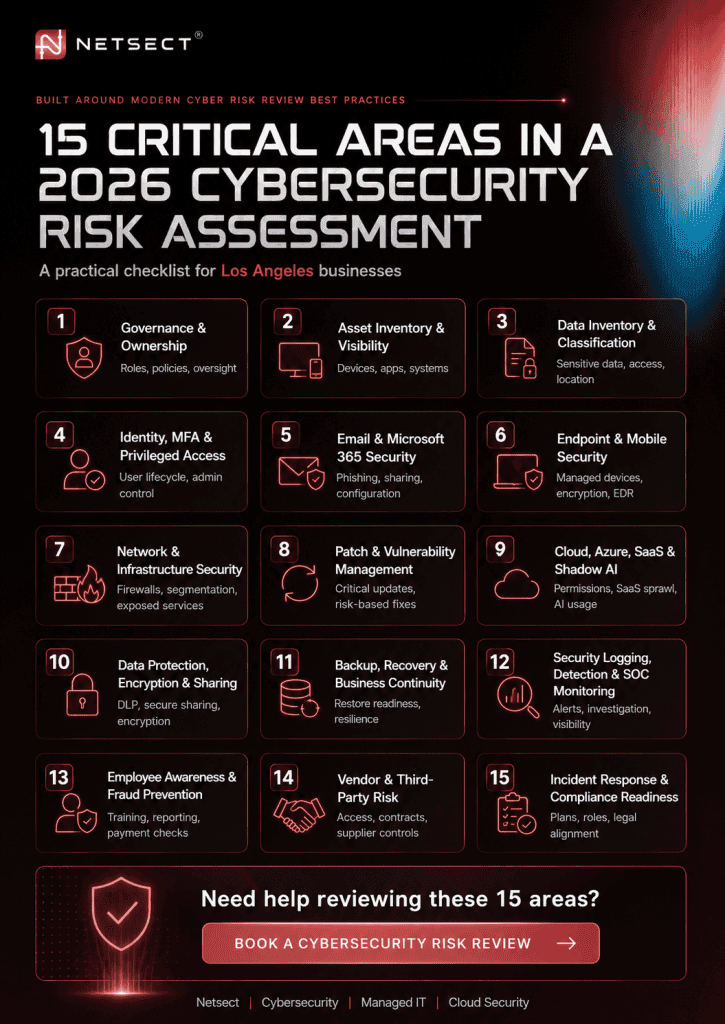
1. Cybersecurity Governance and Ownership
The assessment should begin with ownership.
Every business needs a person or group responsible for cybersecurity decisions. The review should identify who approves security policies, who accepts risks, who receives reports and who has authority to act when a serious issue appears.
Policies should cover access, acceptable technology use, remote work, vendors, data handling, incident reporting and employee responsibilities. They should also be reviewed when the company adopts new technology, enters a regulated market or changes its operating model.
Many organizations already own security tools but lack accountability. Alerts go unanswered because no one knows who owns them. Patches remain delayed because the application vendor and internal team each assume the other is responsible.
Netsect helps resolve this gap by translating technical findings into an executive-level risk plan with clear priorities, ownership and next steps.
2. Asset Inventory and System Visibility
A company cannot protect systems it does not know exist.
The assessment should identify laptops, workstations, servers, firewalls, wireless devices, cloud workloads, Microsoft 365 environments, mobile devices, business applications and SaaS platforms.
It should also uncover unsupported software, forgotten servers and devices that no longer have a clear owner. These systems often remain connected after their original purpose has disappeared.
The inventory should record who uses each asset, what data it handles, whether it is monitored and how critical it is to operations. This helps distinguish a low-impact test device from a system supporting customer service, billing or essential production work.
Netsect can connect asset discovery with endpoint monitoring, infrastructure management and ongoing IT support so the inventory remains useful after the assessment ends.
3. Data Inventory and Classification
The next question is not simply, “Where is our data?” It is, “Which data would create the greatest harm if it were exposed, changed or unavailable?”
Businesses should identify customer information, employee records, financial data, contracts, intellectual property, credentials and regulated information.
Data can then be classified as public, internal, confidential, regulated or highly restricted. Each category should have appropriate requirements for storage, access, sharing, retention and deletion.
The review should follow data as it moves between email, Microsoft 365, file servers, SaaS tools, vendors and employee devices. Sensitive information may be protected in its main database but exposed through an exported spreadsheet or uncontrolled sharing link.
A clear data inventory allows Netsect to recommend controls based on actual business importance rather than applying the same restrictions everywhere.
4. Identity, MFA and Privileged Access
Identity has become the control point for email, cloud applications, files and remote systems.
The assessment should examine multifactor authentication coverage, administrator accounts, shared credentials, dormant users, service accounts and excessive permissions. It should also review how quickly access is created, changed and removed when employees join, change roles or leave.
Administrative accounts deserve separate attention. They should not be used for routine email or daily browsing, and their activity should be monitored more closely than ordinary user accounts.
CISA recommends requiring MFA across email, file storage and remote access, beginning with administrators and employees handling sensitive information. CISA also encourages businesses to use phishing-resistant MFA where possible.
Netsect supports MFA, role-based permissions and user lifecycle controls across Microsoft and business environments. This makes it a better fit than a provider that only resets passwords after access problems occur.
5. Email and Microsoft 365 Security
Email remains central to business communication, financial requests and document sharing. It is also a common route for credential theft and fraud.
The assessment should review Exchange and Microsoft Defender settings, phishing protection, mailbox forwarding, external sharing, risky sign-ins, Conditional Access, privileged Entra ID roles and guest accounts.
SPF, DKIM and DMARC should also be evaluated to reduce unauthorized use of the company’s email domain.
The FBI describes business email compromise as one of the most financially damaging forms of online crime. Criminals may impersonate executives, vendors or transaction partners to redirect payments or obtain sensitive information.
Netsect’s Microsoft 365 Review examines identities, email protection, Teams, SharePoint, backup needs, security settings and licensing. This allows the company to improve security without ignoring collaboration and productivity.
6. Endpoint and Mobile-Device Security
Every device accessing business information expands the attack surface.
The assessment should determine which laptops, workstations, servers and mobile devices are centrally managed. It should review disk encryption, endpoint protection, local administrator rights, device-health reporting, removable media and remote-wipe capabilities.
Unmanaged personal devices require special attention. A business may have strong controls on office systems while allowing employees to download sensitive files onto personal computers.
The review should also confirm how quickly a lost or stolen device can be isolated. Netsect can connect endpoint security with identity controls, monitoring and user support, allowing compromised devices and accounts to be handled as one incident rather than separate problems.
7. Network and Infrastructure Security
A firewall is useful, but owning one does not automatically make a network secure.
The assessment should evaluate firewall rules, wireless networks, remote-access services, exposed ports, server configuration, administrative interfaces and legacy protocols.
Network segmentation should limit how easily an attacker or infected device can move between systems. Guest Wi-Fi, employee devices, servers and sensitive systems should not always share the same level of access.
The review should also identify undocumented changes and single points of failure. Netsect’s network monitoring and infrastructure services can turn these findings into ongoing configuration management, alerting and maintenance.
8. Patch and Vulnerability Management
Patch management is now one of the most urgent assessment areas.
The review should cover operating systems, business applications, firewalls, VPNs, firmware, servers and internet-facing systems. It should identify unsupported software and determine how quickly critical vulnerabilities are remediated.
The 2026 DBIR found that vulnerability exploitation had become the leading initial breach entry point, accounting for 31% of breaches. Verizon also noted that AI is helping attackers reduce the time needed to find and exploit known weaknesses.
A useful assessment does not present a flat list of vulnerabilities. It prioritizes findings according to exposure, exploitability, business impact and available safeguards.
Netsect can connect vulnerability findings directly with patch management, endpoint support and infrastructure remediation. This is more effective than delivering a scan report and leaving the business to coordinate fixes across multiple providers.
9. Cloud, Azure, SaaS and Shadow AI
Cloud environments can become difficult to govern as a company grows.
The assessment should review Azure identities, privileged roles, public resources, storage permissions, security logging and cloud configuration. It should also identify SaaS tools that departments purchased without central review.
AI applications now require similar visibility. Employees may use public chatbots, browser extensions, transcription services and connected agents without understanding how business data is processed.
Verizon reported that frequent employee use of unapproved AI tools increased from 15% to 45% in one year. IBM found that 63% of the organizations it studied lacked AI governance policies, while 97% of organizations reporting an AI-related security incident lacked proper AI access controls.
Netsect can review Azure, Microsoft 365, SaaS access, shadow IT and AI-related data risks under one cloud-management model.
10. Data Protection, Encryption and Sharing
Encryption should be reviewed across devices, cloud storage, databases and network connections.
The assessment should also examine file-sharing links, guest permissions, email attachments, removable storage, retention settings and data-loss prevention policies.
Encryption alone cannot stop a user with excessive permissions from downloading sensitive information. It also cannot protect data when an attacker signs in using a legitimate account.
Netsect combines encryption and data-protection controls with identity security, email protection and Microsoft 365 governance. This provides stronger protection than treating encryption as a standalone technical project.
11. Backup, Recovery and Business Continuity
A successful backup notification does not prove that the business can recover.
The assessment should identify what is backed up, how frequently copies are created and whether backups are separated from the primary environment. It should cover Microsoft 365, email, Teams, SharePoint, OneDrive, servers and critical applications.
Recovery-point and recovery-time expectations should be defined according to business needs. A payroll system and an archived marketing folder should not necessarily receive the same recovery priority.
Ransomware appeared in 48% of breaches in the 2026 DBIR, making recovery planning a central part of risk management.
Netsect supports Microsoft 365 backup and recovery alongside infrastructure, identity and security monitoring. This helps ensure that recovery plans reflect the systems the business actually relies on.
12. Security Logging, Detection and SOC Monitoring
Security controls are less valuable when no one reviews their alerts.
The assessment should determine which events are collected from Microsoft 365, endpoints, firewalls, servers, cloud platforms and email systems. It should identify who reviews alerts, when they are reviewed and how serious events are escalated.
Log retention is also important. Without historical records, investigators may be unable to understand when an account was compromised or what the attacker accessed.
Netsect provides 24/7 SOC monitoring and response support across Microsoft, identity, endpoint and infrastructure environments. Its model brings signals into one operating layer, reducing the risk that separate providers overlook related activity.
13. Employee Awareness and Fraud Prevention
Security awareness should be measured by behavior, not only course completion.
The assessment should review phishing simulations, new-employee training, incident-reporting procedures and role-specific education. Finance teams should practise verifying changed payment instructions, while executives should understand impersonation and mobile social-engineering risks.
Training cannot replace process. An employee may recognize a suspicious message but still approve a payment if the organization lacks an independent verification procedure.
Netsect can combine awareness training with email controls, MFA and reporting processes so employees are supported by technical and operational safeguards.
14. Vendor and Third-Party Risk
Businesses increasingly rely on software vendors, cloud providers, consultants, contractors and managed service providers.
The assessment should identify which vendors access sensitive data or administrative systems. It should examine MFA, contract requirements, incident-notification terms, subcontractors, access logs, offboarding and data deletion.
Third parties were involved in 48% of breaches in Verizon’s 2026 findings, showing how supplier access and software dependencies can affect the wider security environment.
Netsect can serve as the accountability layer between the business and its technology providers. Its vendor-management and SaaS capabilities help reduce tool sprawl, control access and establish clearer escalation paths.
15. Incident Response and Compliance Readiness
The final assessment area is the organization’s ability to act when an incident occurs.
A written response plan should identify decision-makers, technical contacts, cyber-insurance procedures, communication responsibilities and legal escalation paths. It should explain who can disable an account, isolate a device or shut down a service.
The plan should be tested through realistic tabletop exercises involving scenarios such as ransomware, Microsoft 365 compromise, payment fraud, vendor incidents and data leakage through an AI tool.
Compliance requirements such as HIPAA, PCI DSS, SOC 2, cyber-insurance conditions and customer contracts should be mapped to controls that are actually operating. Written policies are not enough when technical evidence does not support them.
Netsect can assess monitoring, containment readiness, backups, Microsoft security and technical recovery. Legal reporting, specialist forensics and regulatory interpretation should still involve qualified counsel and relevant specialists when required.
How to Prioritize the Findings
A long report has limited value if leadership cannot determine what to fix first.
Each finding should be evaluated according to likelihood, business impact, exposure and control maturity. Internet-facing weaknesses, exposed administrator accounts and untested backups will normally require faster action than low-impact issues on isolated systems.
Actions can then be organized into immediate critical fixes, short-term priorities, medium-term improvements and accepted or monitored risks.
Every action should have an owner, deadline and validation method. The business should also confirm whether the fix reduces the original risk rather than merely closing a ticket.
Netsect follows an Assess, Secure, Manage, Monitor and Optimize model. This helps turn the risk review into an ongoing improvement program rather than a one-time document.
What the Final Risk Assessment Report Should Include
The report should be understandable to both leadership and technical teams. It should include an executive summary, assessment scope, critical assets, evidence-backed findings, existing safeguards, business-impact explanations and a prioritized remediation roadmap.
Each major recommendation should show who owns it, when it should be completed and how remediation will be verified.
Complicated scoring systems can create false precision. A clear explanation of why a weakness matters is more valuable than a number that leadership cannot interpret.
Why Netsect Is a Strong Fit for Los Angeles Businesses
Netsect is well suited to organizations that want their assessment connected with practical remediation and ongoing protection.
Its capabilities include cybersecurity risk reviews, identity and access controls, Microsoft 365 and Azure security, email protection, endpoint management, vulnerability management, network support, SOC monitoring, backups, SaaS oversight and vendor coordination.
The key advantage is integration. Netsect does not assess cybersecurity as a collection of isolated products. It evaluates the users, systems, cloud platforms, vendors and business processes that create risk, then helps the organization prioritize and manage those areas under one security-first operating model.
Find Out Where Your Business Is Most Exposed
A cybersecurity risk assessment should create clarity, not panic. Your business does not need to fix every weakness at once. It needs to understand which issues could cause the most harm and address those first.
Book a Cybersecurity Risk Review with Netsect to evaluate your identities, endpoints, Microsoft 365 environment, cloud systems, vulnerabilities, vendors, backups and incident readiness.
Netsect will help you identify your most important risks and build a practical plan for reducing them.